Chicago Restricted Access Continues, Mask Rule Passes, Trump Executive Actions
Wednesday, August 12, 2020
The Illinois Restaurant Association continues to engage with local, state, and federal officials to help our employers and employees address concerns about COVID-19. Please see the below resources and information for your business - updated as of 6:10 p.m. on Wednesday, August 12.
*** Chicago Central Business District Restricted Access Continues from 9:00 p.m. to 6:00 a.m. Through Monday The city of Chicago will temporarily restrict access to the downtown area overnight through the weekend. Restricted access will be in place from 9:00 p.m. – 6:00 a.m. Note: some streets will begin to reopen as early as 5:00 a.m. with access restored by 6:00 a.m. The Office of Emergency Management and Communications is coordinating efforts with various city departments and sister agencies on the response. Following the looting and civil unrest experienced in the early hours of Monday morning, the city will continue to implement its Neighborhood Protection Plan across all of Chicago’s communities. As part of an all-hands-on-deck safety plan, OEMC will deploy more than 100 infrastructure assets from the Department of Transportation, the Department of Streets and Sanitation and the Water Department, who are working in concert with the Chicago Police Department to keep residents safe citywide. These resources have been deployed throughout the city — particularly along our neighborhood commercial corridors — to further protect our communities’ residents and critical businesses, such as grocery stores and pharmacies. The Chicago Police Department citywide teams will be used to supplement staffing for the districts, including the downtown area. Additionally, district-assigned officers whose shifts have been extended and days off canceled will be dedicated to neighborhoods across the city. This evening through Monday, August 17 at 6:00 a.m., access to the downtown area will be temporarily restricted from 9:00 p.m. – 6:00 a.m. The restricted access to the downtown area is NOT a curfew. All residents, workers and employers whose businesses are located downtown will have access at all times. As part of the restricted access, the following measures will be in place until further notice: Lake Shore Drive will be closed between: Downtown Bridges: All Bridges will be up by 9 p.m. with the exception of the following: Access Points for residents and employees of area businesses: Harrison Street Chicago Avenue and Halsted Street Roosevelt Road and Canal Street Kinzie Street and Halsted Street LaSalle Street
Expressway Closures: CTA: Rail Service will be impacted at the following locations, with trains not entering the area surrounding downtown: Fullerton Avenue to 47th and east of Halsted Street Bus Service will remain open at this time. Some buses will see reroutes due to bridge and street closures.
CDOT: Access points are designated for residents, all workers and employers whose businesses are located within the designated boundaries, individuals who reside in the surrounding area and residents engaged in essential activities. Entrance into the perimeter will be manned by officers with the Chicago Police Department. When arriving at the access points, residents and employees should show identification or proof that they live in the area and/or work in the area. To receive emergency alerts for updates on street closures and public transportation, subscribe to Chicago’s text or email alert system at NotifyChicago.org or follow the Office of Emergency Management and Communications (OEMC) on Facebook and Twitter @ChicagoOEMC. JCAR Passes Rule to Enforce Public Health Guidelines and Issue Warnings and Fines on Businesses Yesterday, the Joint Committee on Administrative Rules (JCAR) voted to approve Illinois Department of Public Health (IDPH) emergency rules proposed by Governor J.B. Pritzker that impose a new penalty on businesses that do not comply with mask requirements or public health guidelines. The rules will be enforced by local and state authorities, including local police, health departments, and liquor commissions. Click here to read the rule. There is a three step process under the IDPH rules: Written warnings will be issued to businesses and encouraged to comply with public health guidelines. Businesses that do not comply will be ordered to have some or all of their patrons leave the premises to come into compliance. Businesses that do not comply could be cited with a Class A misdemeanor and subject to a daily fine of $75 to $2,500.
The IRA urges all individuals and businesses to comply with all local and state public health guidelines. We encourage all restaurants and bars to download and post the Illinois Restaurant Promise in English and Spanish at their establishments. Click here to read more from WGN. Analysis of President Trump's Executive Actions, Relief Negotiations With COVID-19 negotiations stalling over the past week, President Trump took executive action Saturday to provide some narrow relief. The orders aim to deliver additional jobless benefits, payroll tax relief, slow evictions, and assist with student loan repayment. Democrats and some Republicans have questioned the legality of these actions. The actions include: Extended unemployment benefits – Trump diverted $44 billion from the Federal Emergency Management Agency (FEMA) to provide $400 a week in enhanced unemployment benefits. The federal government would provide 75 percent of the payment, with the states providing the rest. Trump’s memo orders the aid to last through December 6th, or until funding runs outs, which could be much sooner than December 6th with tens of millions on unemployment. Payroll Tax Deferral – The president instructed the Treasury Department to halt collection of payroll taxes from September 1st through the end of the year for workers who earn less than $4,000 every two weeks (around $104,000 per year). During the signing, Trump called on Congress and Democratic Nominee Joe Biden to commit to making the deferral a permanent tax cut. The president also mentioned hoping to make this deferral retroactive to August 1st and promised he would seek to relieve the tax liability if reelected. Eviction Moratorium – Less binding than the other actions, Trump’s memo to the Department of Health and Human Services (HHS) and the Centers for Disease Control and Prevention (CDC) calls on those agencies to “consider” whether an eviction ban is needed. This action does not reauthorize the moratorium included in the CARES Act or explicitly halt evictions. The president also said his directive to extend a moratorium on evictions would include financial assistance from the Department of Housing and Urban Development (HUD) for struggling renters and homeowners. Student Loan Relief – This memo waives all interest on federally held student loans through the end of 2020 and allows people to delay payments until December 31st. Both Sides Still Willing to Pursue Additional Relief On Sunday, negotiators from both sides said they were still willing to continue negotiations on a relief package. Speaker Pelosi said negotiators still needed to reach a deal and assured her side was open to meeting “halfway.” Secretary Mnuchin said on the prospects of continued negotiations, “Any time they have a new proposal, I'm willing to listen.” Negotiators still have a number of priorities not addressed through Trump’s actions, including aid for states and localities, funding for schools to reopen, and implementing a COVID-19 liability shield. It is currently unclear how negotiations may progress, but we should know more early this week. What this Means for Timing on the Next COVID Relief Package It is very difficult to predict if a package will come together this week. Arguably, both parties recognize how critical it is to our nation, and the economy, to pass the measure prior to going on recess. At the same time, they are far apart on several key pieces and a deal may prove to be elusive to reach. One option could be to pass a small “skinny bill,” which covers the narrow issues that the parties can agree upon, pushing a broader deal down the road. But, even the likelihood of a skinny bill passing is in question, given the broader dynamics on reaching an agreement. Of note, if a deal is not reached this week, it is likely that both parties will walk away and recess until their national conventions conclude (Democratic August 17-20, Republican August 24-27). Under this scenario, the parties would return in September and presumably work to reach a much larger agreement that would cover another round of COVID relief and a large appropriations package to fund the government through the remainder of the year. Watch on Demand: Sam Toia Addresses City Club of Chicago 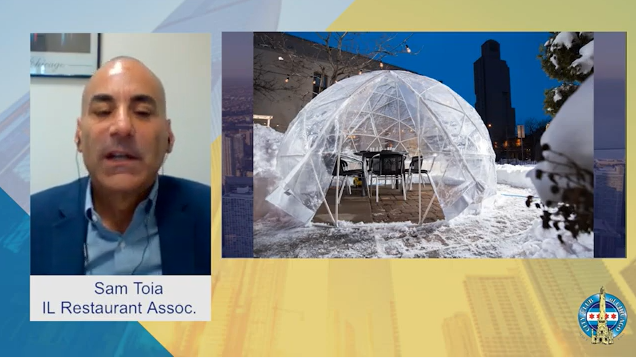
Earlier today, IRA President & CEO Sam Toia addressed the City Club of Chicago to discuss the current challenges and outlook for the restaurant and hospitality industry, developments in Washington, ways to help local restaurants, and more. Click here to watch Sam's presentation. Read more: Who Do You Know? Take Our Elected Official Relationship Survey As we continue to advocate on behalf of the industry during COVID-19, the IRA and National Restaurant Association are working to identify existing and new relationships our members have with local, state, and federal elected officials. The results will allow us to get a comprehensive sense of which restaurant operators have relationships with lawmakers across the state. Amplifying our industry’s story begins with you, and we greatly appreciate your participation. Click here to take the two minute survey. 
|

 Email to a Friend