What To Do If A COVID-19 Case Is Confirmed in Your Facility, ILCC Delinquency List, Chicago Gourmet
Tuesday, June 30, 2020
The Illinois Restaurant Association continues to engage with local, state, and federal officials to help our employers and employees address concerns about COVID-19.
Please see the below resources and information for your business - updated as of 2:20 p.m. on Tuesday, June 30.
***

Chicago Gourmet will take on a new format come September. Our team at the Illinois Restaurant Association, along with Presenting Sponsor Southern Glazer’s Wine & Spirits – will soon reveal new programming for this year that celebrates Chicago’s diverse culinary landscape. With the guidance of health experts and public officials, the outdoor epicurean gathering traditionally held in Chicago’s Millennium Park will be suspended until September 2021.
We are pleased to be developing a series of experiential events championing a range of cuisines, chefs, beverage experts and more. These intimate experiences will give enthusiasts a front row seat to the talented individuals who make up our vibrant dining communities.
During September 2020, Chicago Gourmet will feature several unique dinners, tastings and collaborative events. Taking place in person at restaurants and small venues citywide, functions will be limited in size to comply with current phasing and public safety requirements and designed for a range of interests and appetites. The lineup also includes Go Gourmet - a compelling series of virtual discussions and demos - that allows fans to participate from the comfort of their living rooms or home kitchens.
Chicago Gourmet’s commitment to community remains steadfast. Events and charitable programs will be announced later this summer at chicagogourmet.org.
What to Do - COVID-19 Positive Case in Your Facility
The IRA has developed a guide of protocols to follow when a confirmed COVID-19 case has been in your facility.
The guide includes: general best practices, cleaning and disinfecting policies, employee leave requirements, notification templates, and more.
Click here to review the guidelines.
Share the Illinois Restaurant Promise
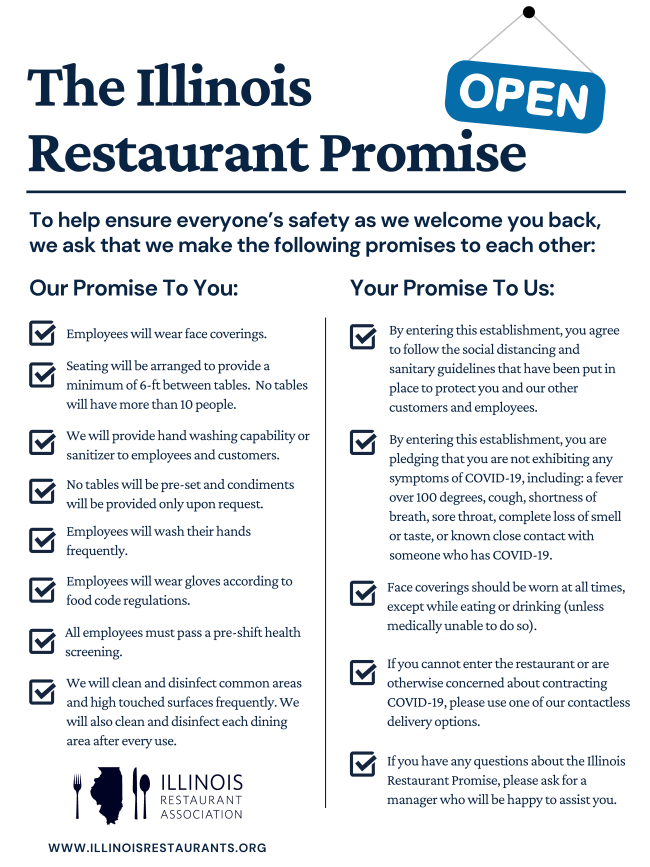
In partnership with the IRA and health officials across the state, restaurant owners and operators make these commitments to earn this endorsement during the COVID-19 recovery period.
When customers see this endorsement, they can be comfortable that the restaurant is taking all necessary steps to protect their employees and customers and is committed to playing a leadership role in protecting our communities.
Download the poster in English and Spanish for your establishments.
ILCC Retailer Delinquency List Resumes July 27
As of June 2, 2020, state law suspended pending retailer delinquencies until 30 days after the beginning of Phase 4 of the Governor's Restore Illinois Plan.
On June 26, 2020, the Governor ordered that the entire State progress into Phase 4 of the Plan. Therefore, on July 27, 2020, the State Commission will post an updated Delinquency List and will continue to post updated lists every subsequent Thursday as required by the Liquor Control Act.
-
Retailers that had been listed on the most recently posted Delinquency List who have not cured the delinquency will again be reported delinquent on July 27, 2020.
-
Retailers who became delinquent during the Delinquency List suspension period (over the last month) who haven’t cured their debt will also be reported delinquent on July 27, 2020.
-
Retailers who are currently delinquent but who satisfy their delinquency debt before July 27, 2020, should not reappear on the Delinquency List on July 27, 2020.
-
Retailers who appear on the Delinquency List on or after July 27, 2020 may pay the delinquency debt at any time and be removed from the Delinquency List within 24 hours of clearing the debt.
-
On or after July 27, 2020, pursuant to 235 ILCS 5/6-5 of the Illinois Liquor Control Act, distributors will be prohibited from selling and delivering wine and spirits to retailers who continue to be named on the Delinquency List (even for debts owed to distributors prior to or during the suspension period).
All previously reported bona fide disputes filed pursuant to Illinois Liquor Control Commission “Guidance on Thirty (30) Day Credit Law Reporting – Retailer Delinquencies - Bona Fide Dispute Process" have been voided.
All retailers, previously filing bona fide disputes, will be reported delinquent at the termination of the Delinquency List suspension period. If a retailer is named on a published Delinquency List on or after July 27, 2020 and has a good faith bona fide dispute of the amount that is owed, the retailer may file (or refile) a “bona fide dispute” with the Commission at that time.
Click here to read the updated ILCC guidance.
Click here to read the updated FAQ from ILCC.
Cocktails for Hope Bottle Purchase Program
IRA member Julia Momose of Kumiko - founder of Cocktails for Hope - has launched a bulk bottle purchase program for restaurants and bars that need containers to sell cocktails to go.
Bottles are 375mL glass, flask shape and include a tamper-evident plastic screw-on cap that can be applied by hand that. Bottles come in cases of 24 only. Price is $22.50/case which includes caps. You will receive 2 extra caps per case of bottles. Bottles and caps may not be purchased separately.
Click here to make a purchase.
Cook County Updated Budget Projections
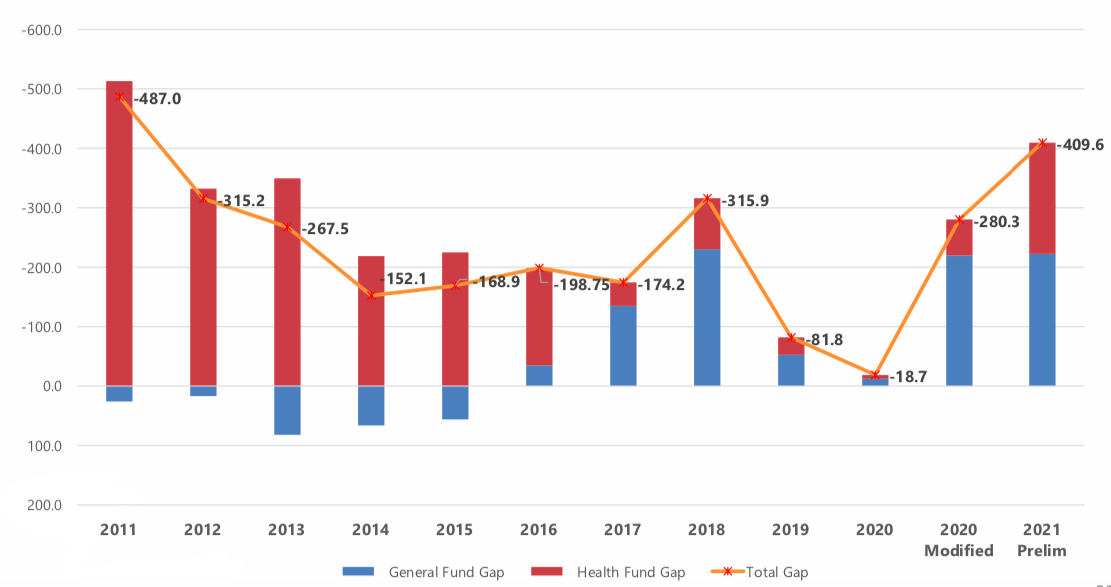
Last week, Cook County provided the IRA and other business groups with a preliminary budget projection for the remainder for FY 2020 and FY 2021.
Cook County is facing a $410 million budget deficit for 2021, the highest mid-year gap projected by county officials in a decade. This year's budget has also been heavily impacted by COVID-19, and is falling $280 million below projected revenues.
The county is legally bound to close both gaps by the end of the fiscal year in November.
The IRA will work to protect the restaurant and hospitality industry as Cook County considers various revenue proposals during budget negotiations in the fall.
Click here to review the county's budget forecast for FY2020 and FY2021.
State of Illinois Phase IV - Guidelines for Restaurants and Bars
Last Friday, all four regions of the state transitioned into Phase IV of the Restore Illinois framework for reopening. Earlier this week, Governor J.B. Pritzker released the Restore Illinois Phase IV Guidelines for Reopening for various industries, including restaurants and bars. Click here to read the full announcement.
Click here to read the Phase IV Guidelines for indoor and outdoor dining at restaurants and bars.
A state of Illinois Phase IV reopening toolkit for restaurants and bars is also available here.
Restaurants and bars located in the city of Chicago must follow the city's Phase IV - Gradually Reopen guidelines for restaurants and bars. Restaurants and bars should refer to local authorities and health departments for additional guidelines during Phase IV.
City of Chicago Phase IV: Liquor Sales End at 11:00 p.m.
Last Friday, the city of Chicago transitioned into Phase IV. Restaurants are now permitted to resume indoor dining at 25% occupancy per room - or 50 people per room (whichever is fewer) - at the beginning of Phase IV.
As a reminder, under the amended and reissued Public Health Order 2020-05, all liquor sales for on-premises consumption at Chicago restaurants and bars must cease at 11:00 pm.
If your establishment sells liquor, all liquor sales must stop at 11:00 p.m. Food sales can continue until the time established on your retail food license.
All liquor sales of packaged goods for off-premises consumption, via delivery or carry-out, must cease at 9:00 pm.
Please read the industry notice and download the required posting for more information.
BACP has provided the following clarifications and guidance related to occupancy:
-
In order to determine 25% occupancy:
-
Use occupancy placard and divide by 4
-
OR, calculate square footage of indoor space and then divide by 60.
-
Restaurants should use total square footage to determine 25% occupancy, not just dining room space
-
Business owners may determine how a "room" is defined. The city's intention is that all rooms are fully separate
-
Staff should not be included in the 50 per room or capacity calculations
-
Tables and seats in a room where 50% or more of a wall can be removed via the opening of windows, doors, or panels do not count toward indoor occupancy, provided that dining tables are within 8-ft from such outdoor openings
Click here to read the Phase IV - Gradually Reopen guidelines for restaurants and bars.
The IRA has compiled the various operational guidelines that Chicago restaurants and bars must be aware of as they reopen, including: sidewalk café and expanded outdoor dining FAQs, federal paid sick leave requirements, cocktails to go regulations, 11:00 p.m. ending time for alcohol sales notice, and more.
Click here to review the guidelines.
Minimum Wage and Tipped Wage Increases in Effect July 1, 2020
On July 1, 2020, minimum wage and tipped wage increases go into effect for the state of Illinois, Cook County, and city of Chicago.
Please review the below rate increases and take action accordingly for your business.
State of Illinois
-
Current minimum wage - $9.25
-
Current tipped wage - $5.55
-
Minimum wage starting July 1, 2020 - $10.00
-
Tipped wage starting July 1, 2020 - $6.00
Click here for more information on the state of Illinois' minimum wage law.
Cook County*
-
Current minimum wage - $12.00
-
Current tipped wage - $5.25
-
Minimum wage starting July 1, 2020 - $13.00
-
Tipped wage starting July 1, 2020 - $5.30
Click here for more information on Cook County's minimum wage law.
*More than 100 municipalities within Cook County have opted out of Cook County's minimum wage ordinance. Please check with your local authorities to confirm whether or not this law applies to your business. If your municipality has opted out of Cook County's minimum wage ordinance, you must follow the state of Illinois' minimum wage law. Employers with tipped employees should take special note that they should pay the higher Illinois tipped wage of $6.00 per hour than the lower Cook County tipped wage of $5.30.
City of Chicago**
-
Current minimum wage - $13.00
-
Current tipped wage - $6.40
-
Minimum wage starting July 1, 2020 - $14.00
-
Tipped wage starting July 1, 2020 - $8.40
Click here for more information on the city of Chicago's minimum wage law.
**Effective July 1, 2020, small employers (4-20 employees) in the city of Chicago are required to pay employees a minimum wage of $13.50 and a tipped wage of $8.10
City of Chicago Fair Workweek Ordinance in Effect July 1, 2020
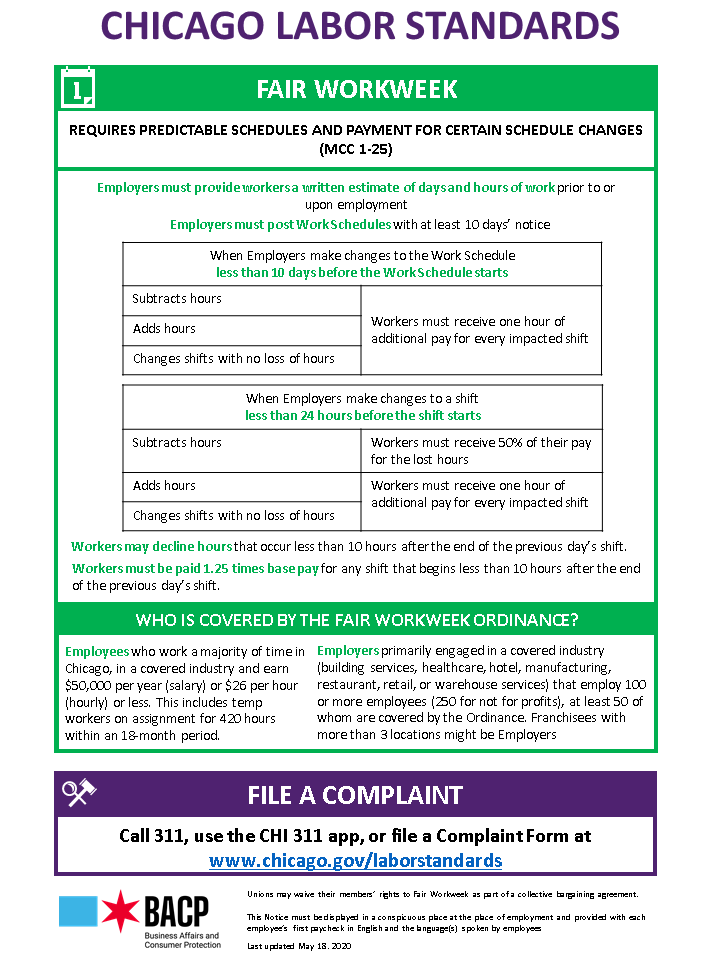
The city of Chicago's Fair Workweek Ordinance goes into effect on July 1, 2020. Employees are covered by the ordinance if they work in one of seven “covered” industries (Building Services, Healthcare, Hotels, Manufacturing, Restaurants, Retail, and Warehouse Services), they make less than $26/hour or $50,000/year, and the employer has at least 100 employees globally (250 employees and 30 locations for a restaurant).
Restaurants with less than 250 employees and less than 30 global locations are exempt from this ordinance. Unless your restaurant has 30 or more locations globally, your restaurant is exempt from this ordinance. Franchisees with 3 or fewer locations owned by one employer are also exempted
Covered employees are given:
-
Advance notice of work schedule (10 days beginning July 1, 2020)
-
Right to decline previously unscheduled hours
-
1 hour of Predictability Pay for any shift change within 10 days
-
Right to rest by declining work hours less than 10 hours after the end of previous day’s shift
Click here to read more.
State of Illinois Business Interruption Grant Application
Last Friday, the Department of Commerce and Economic Opportunity (DCEO) opened the application for the first round of Business Interruption Grants (BIG). The BIG program will provide $60 million to businesses experiencing losses or business interruption as a result of COVID-19 related closures.
-
The BIG Program is available for up to 3,500 businesses that experienced a limited ability to operate due to COVID-19 related closures.
-
DCEO will begin distributing funds to qualifying businesses in early July.
-
The total program funding will amount to at least $540 million in grants for small businesses, $270 of which has been set aside for childcare providers, and is funded by the CARES Act.
In the first wave of grants, priority will be given to small businesses that have been heavily restricted or completely shut down during the pandemic and are located in disproportionately impacted areas (DIAs).
-
Businesses eligible for the program must have experienced extreme hardship, demonstrated by eligible costs or losses in excess of the grant amount, since March and may continue to face depressed revenues or closure.
-
Businesses must also have been in operation for at least three months prior to March 2020.
-
An emphasis will also be placed on those businesses that are located in areas that have experienced recent property damage due to civil unrest, exacerbating the economic impacts of COVID-19.
Specifically, the program includes support for:
-
Businesses in DIAs - $20 million for businesses that are located in a subset of DIAs that have recently experienced significant property damage, providing 1,000 grants of $20,000 each
-
Bars and Restaurants - $20 million for bars and restaurants unable to offer outside service, providing at least 1,000 grants of up to $20,000 each
-
Restaurants and bars with under $3 million in annual sales will be eligible to apply
-
Barbershops and Salons - $10 million for barbershops and salons, providing 1,000 grants of $10,000 each
-
Gyms and Fitness Centers - $10 million for gyms and fitness centers that have lost significant revenue due to COVID-19, providing 500 grants of $20,000 each
Click here to start an application.
|

 Email to a Friend